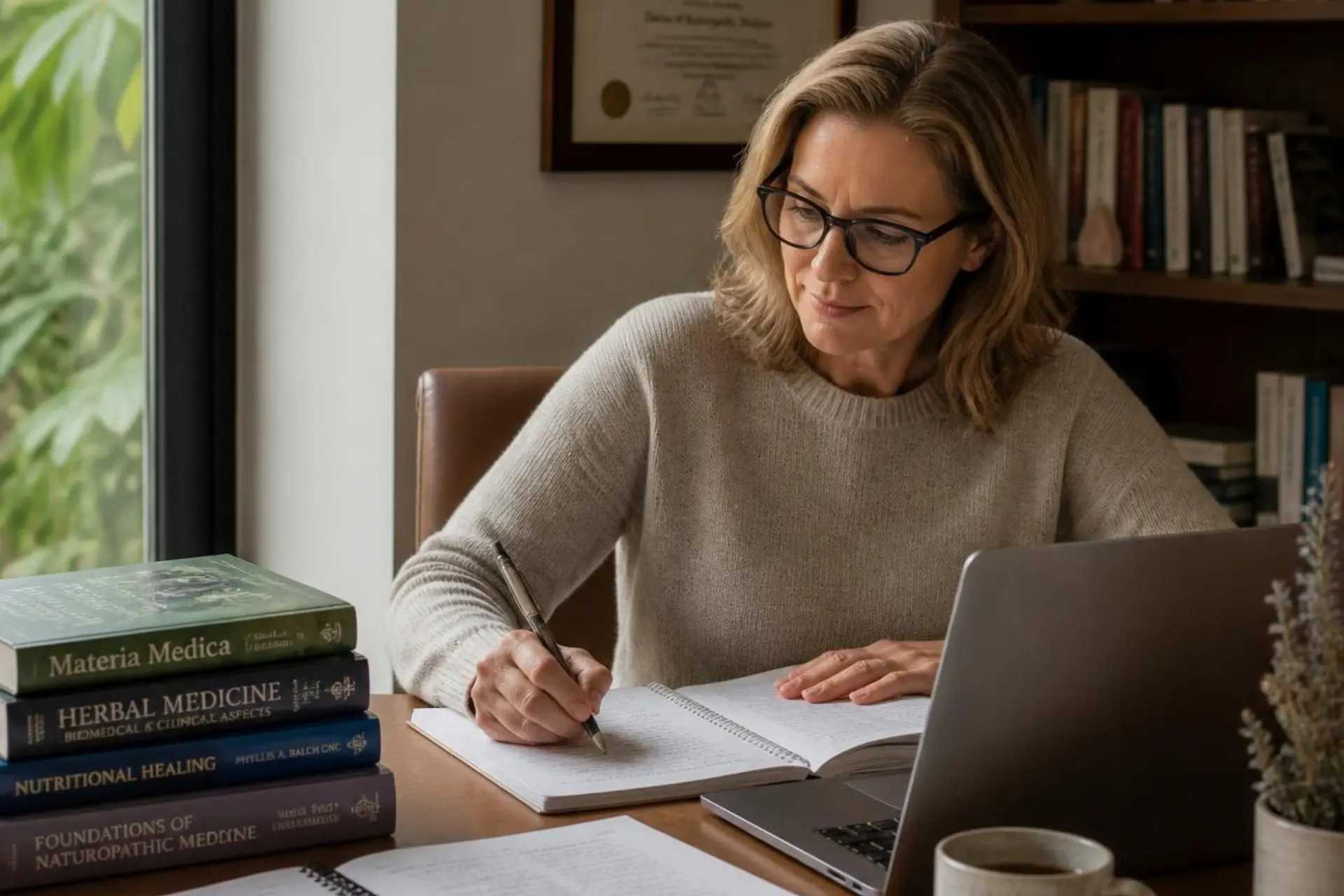
There is no shortage of natural health information online. Within seconds, you can find articles, videos, podcasts, and social media posts on almost any health topic, from nutrition advice on your phone to discussions about herbal medicine and practitioners’ perspectives.
However, having access to information is not the same as receiving a professional education.
If you’re thinking about working in natural and complementary health, it’s not just about what you’ll learn. It’s about feeling ready to use that knowledge when you’re sitting with a real client, knowing what to ask, how to think things through, and when to seek further guidance.
The worry is not simply that you will choose the wrong subjects. It is that you could invest time and money in a qualification, then still feel unsure how to think, communicate, or work responsibly with a client.
Professional natural health education is different because it goes beyond access to information. It provides a structured framework for developing knowledge, connecting concepts, building professional reasoning, and understanding how learning can be applied within an appropriate scope.
That matters if you want your education to support more than personal interest. You need a pathway that helps you understand not only what you are learning, but how it fits into professional practice.
So what does that kind of professional education need to give you beyond information?
Professional Education Should Teach You More Than Information
Information is only the starting point.
Professional education should take you beyond remembering facts. It should help you understand how different areas connect and how to apply what you learn in professional practice.
Here’s an example: nutrition is more than knowing what foods are healthy. It also involves understanding the body, individual needs, and the limits of your role.
This is where learning in a deliberate sequence makes a difference.
It gives you the opportunity to build your understanding progressively rather than simply collecting information from disconnected sources.
A programme should give you more than a basic understanding of a subject. It should help connect ideas, ask better questions, and make thoughtful decisions. That kind of understanding doesn’t happen by chance. It depends on how the programme is built.
Why Does Structured Education Matter?
Natural and complementary health covers a broad range of disciplines, including:
● Naturopathy
● Nutritional medicine
● Herbal medicine
● Mind-body medicine
Each discipline has its own body of knowledge and its own practical considerations. Without a clear sequence, it can be difficult to see how subjects connect, which concepts need to come first, and how earlier learning supports more advanced professional application.
Foundational knowledge supports more advanced study, helping students build a connected understanding rather than learning individual topics in isolation.
The way a programme is designed influences what you learn, when you learn it, and how your understanding develops over time. It can shape how confidently you can explain the connections between different areas of study and apply that knowledge within your intended professional role.
The way a programme is designed influences what you learn, when you learn it, and how your understanding develops over time. It can shape how confidently you can explain the connections between different areas of study and apply that knowledge within your intended professional role.
From Information to Professional Reasoning
Professional education should also change the questions you ask. Instead of simply asking, “What is this?”, you begin to ask:
● Why is this relevant?
● How does this connect to other areas?
● Is this appropriate within my scope?
● What information do I still need?
● When should another professional be involved?
This is part of developing professional reasoning. It means learning to consider information in context, recognise the limits of your knowledge and role, and make responsible decisions. It also means understanding that knowledge is not applied in isolation: practitioners need to consider the individual, the information available, their scope of practice, and whether referral or collaboration is appropriate.
This is the kind of preparation prospective students should look for when comparing professional education. It is also a principle that shapes how ICNS designs its programmes.
What Does Studying at ICNS Look Like?
The International College of Naturopathic Science (ICNS) trains students to practise as naturopaths, herbal medicine practitioners, nutritional medicine practitioners and mind-body medicine practitioners and, through that training, as Integrative Health Practitioners. Programmes are delivered online and accredited across 36 countries through the International Institute for Complementary Therapists (IICT). Each Bachelor and Advanced Diploma is a full three-year programme, built on more than two decades of curriculum development, with intensive and part-time pathways available. ICNS prepares practitioners to work responsibly alongside GPs, with measurable, accountable outcomes within a defined scope of practice.
Students work through a defined curriculum, building their knowledge progressively rather than approaching each subject as an isolated area of study.
Online learning also asks students to take an active role in their education. It requires you to engage with the course material, manage your study time, and develop your understanding over time. While online study offers flexibility, it still requires discipline, consistency, and active participation.
To help with that transition to your new role as a student, applicants receive access to the ICNS Induction Programme: four short courses in Study Skills, Self-Discipline, Academic Writing and Referencing, and Healthy Nutrition, before their programme begins.
A curriculum is more than a list of subjects. It shapes how knowledge is organised, how concepts build on one another, and how students progress through their education.
For prospective students, understanding both how a programme is designed and the experience behind its curriculum can be just as important as looking at the subjects themselves. It shows how education is designed to help students build knowledge progressively and develop a stronger understanding of their chosen field.
When you look at education this way, the question is no longer simply which subjects are included. It becomes whether the programme helps those subjects develop into useful professional understanding.
Education Should Build Understanding
Learning more is only part of the picture. Strong natural health education should help you think critically, make connections, ask better questions, and know how to put your knowledge into practice responsibly.
That is why the way an education is designed matters.
A programme designed to build step by step can help you see how knowledge develops over time, how concepts relate to one another and how professional reasoning is built. Over time, it also helps you develop the judgement to use what you’ve learned in a practical, thoughtful way.
At ICNS, we believe professional education in natural and complementary health should offer more than information. It should provide a foundation that develops step by step, builds understanding over time, and helps students develop the judgement to apply what they learn responsibly in practice.
If you are comparing programmes, look beyond the course title and subject list. Pay attention to how learning develops from foundational knowledge into professional application, how professional reasoning is developed, and how scope is addressed.
Choosing where and how to study is a significant step. If you are comparing programmes, look beyond the subject list and consider how the curriculum builds knowledge, professional reasoning, and responsible practice over time.
Learn more about the curriculum and educational approach behind ICNS programmes:
If you are still weighing up how programmes compare, send us your question directly. We would rather answer it properly than leave you guessing.