International College of Naturopathic Science
What is
Naturopathic
Science?
A clinical discipline that applies the rigour of evidence-based science to the principles of natural medicine producing practitioners who are qualified, accountable, and fit for a modern healthcare environment.
More than natural health. A clinical science.
THE DISCIPLINE
The word ‘naturopathy‘ describes a philosophy of care. Naturopathic science is what happens when that philosophy meets clinical methodology, evidence-based research, and rigorous professional training.
At ICNS, the distinction is deliberate. We educate practitioners who can articulate not just what they recommend, but why — drawing on physiology, biochemistry, clinical nutrition, and a working knowledge of the medical landscape they practise alongside. That is what makes our graduates fit for the modern health economy.
This is not a retreat from naturopathic principles. It is a commitment to upholding them to the highest possible standard — one that earns the respect of patients, peers, and referring physicians alike.
Natural Health
TRADITIONAL FRAMING
Rooted in tradition, lifestyle guidance, and
wellness philosophy. Valuable — but without a
clinical framework, it remains outside the
conversation that shapes healthcare policy,
referral networks, and patient trust.
Naturopathic Science
THE ICNS STANDARD
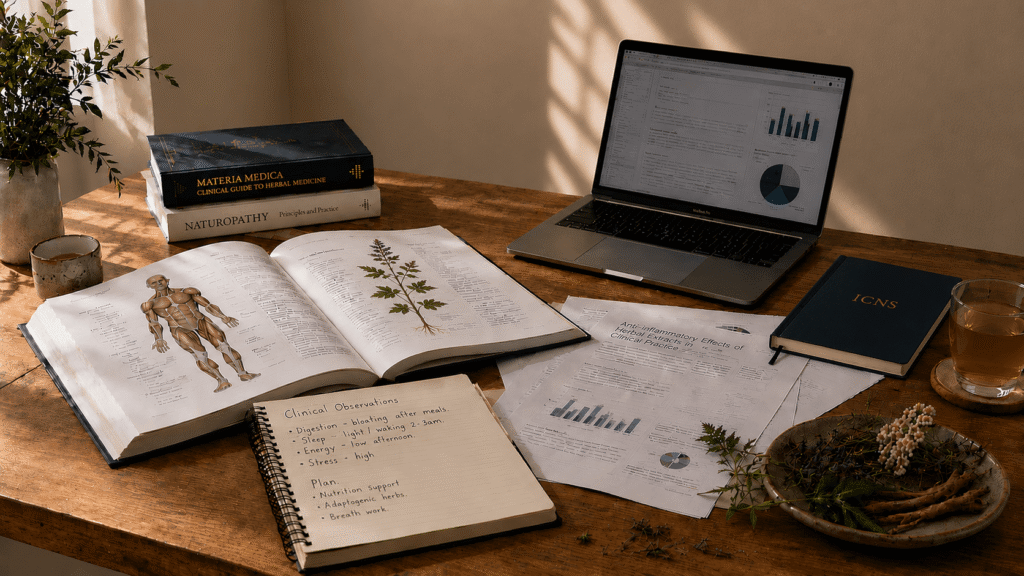
The same foundational principles, grounded in clinical science. Evidence-informed methodology. A practitioner who can work within — and be accountable to — a broader medical environment. This is what ICNS trains.

The foundations that inform everything.
GUIDING PRINCIPLES
Naturopathic science is built on a set of principles that have stood for over a century — not because they are doctrine,
but because they hold up under clinical scrutiny. These are not simply values. They are the operating logic of every
case assessment, every recommendation, every referral decision.
I
Vis medicatrix naturae.
The healing power of nature. The practitioner’s role is to understand and support the body’s own capacity to restore balance — not to override it.
This principle shapes how we assess, and what we teach.
II
Treat the whole person.
Biological, environmental, psychological, and lifestyle factors are assessed together. No system in the body operates in isolation — and neither
does a person’s health. The whole picture is the only picture worth treating.
III
Identify and remove the cause.
Symptoms are signals, not the story. Naturopathic science trains practitioners to trace presentations back to underlying drivers — dietary, biochemical, environmental — rather than simply managing what appears on the surface.
IV
First, do no harm.
Every recommendation carries a risk-benefit assessment. Naturopathic science requires practitioners to understand contraindications, potential interactions, and clinical red flags — and to act accordingly. Safety is not an afterthought. It is the starting point.
The Integrative Health Practitioner
GRADUATE IDENTITY
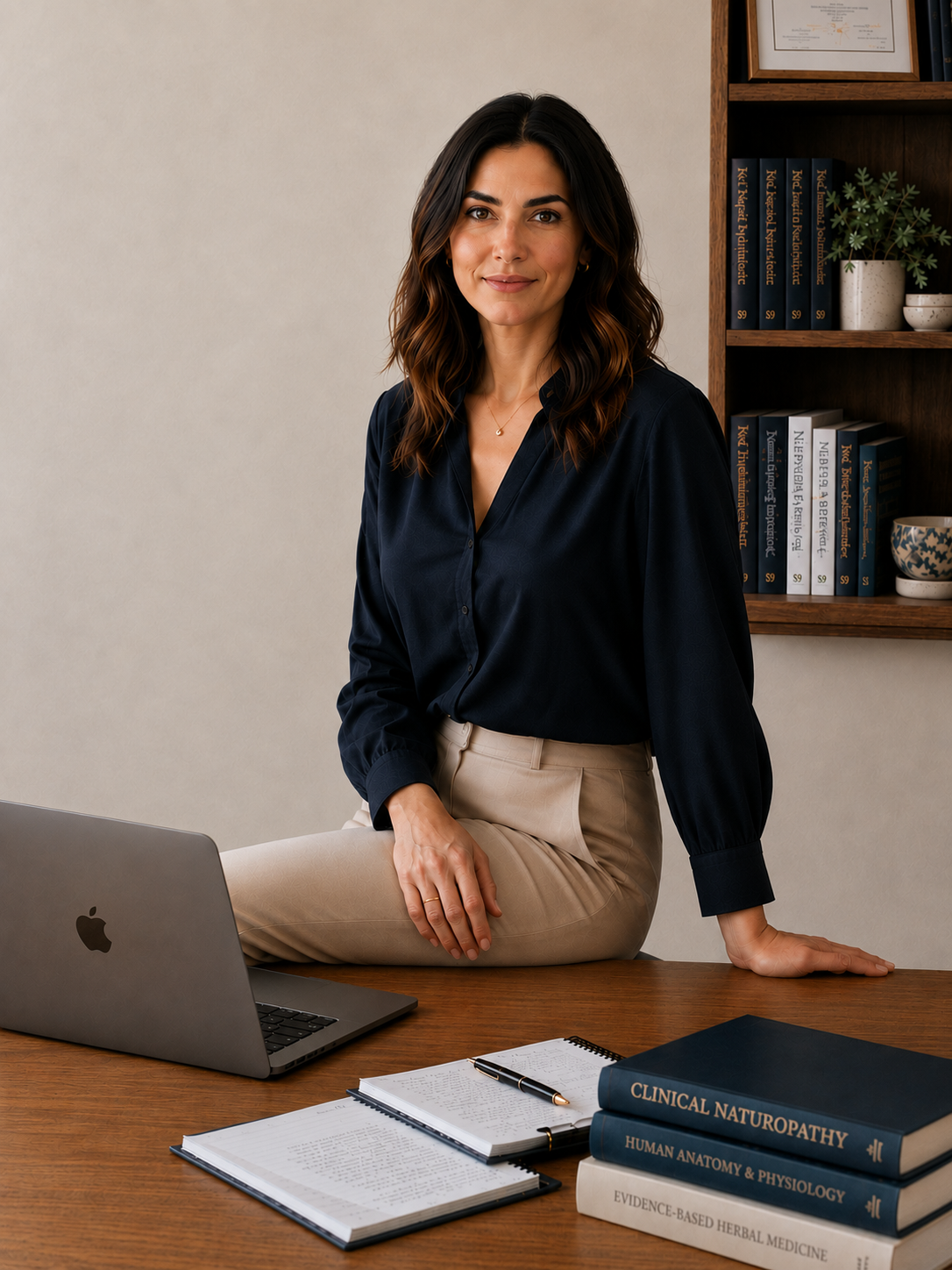
ICNS graduates do not enter practice simply as ‘naturopaths’. They enter as Integrative Health Practitioners — a designation that reflects both the breadth of their training and the context in which they are qualified to work.
The term is precise. ‘Integrative‘ signals that these practitioners operate within a healthcare ecosystem, not outside it. Their clinical education is designed to produce graduates who are capable of working alongside GPs, specialists, and allied health professionals — contributing meaningfully to a patient’s overall care rather than existing in parallel to it.
1
A clinical case history, not a wellness chat.
Integrative Health Practitioners are trained to conduct structured clinical assessments — covering presenting
symptoms, health history, dietary patterns, environmental exposures, medications, and psychosocial context — before forming any view on how to proceed.
2
Evidence-informed recommendations.
Protocols are developed against a working knowledge of clinical nutrition, phytotherapy, lifestyle medicine,
and pathophysiology. Recommendations are traceable to evidence and defensible in a professional context.
3
A clear and respected scope of practice.
Integrative Health Practitioners know what they can do, and what they cannot. They do not diagnose medical
conditions, prescribe pharmaceutical medication, or treat medical emergencies — and their training makes
the reasons for that boundary as clear as the boundary itself
4
Referral as a clinical skill.
Knowing when to refer — and to whom — is one of the most important competencies an integrative practitioner can hold. ICNS training treats referral not as an admission of limitation, but as a mark of clinical
intelligence and professional integrity.
5
Professional accountability.
ICNS graduates are trained for accredited, insurable, professional practice. That means documentation
standards, ethical frameworks, continuing professional
development, and a commitment to operating within a code of conduct that protects both the client and the
credibility of the profession.
Clinically confident. Medically aligned.
WHAT SETS THIS APART
The Integrative Health Practitioner identity is not marketing language. It reflects a training model built around clinical reasoning, professional accountability, and genuine collaboration — producing graduates who earn a place in the healthcare landscape rather than simply competing for one on the margins.
Naturopathic science
works with medicine.
COLLABORATION IN PRACTICE
This is the argument that naturopathic science makes — not by assertion, but by producing practitioners who are educated, accountable, and able to hold a credible conversation with every other professional in a patient’s care team.
The most common unmet need in primary healthcare is not a gap in diagnostic technology. It is the absence of a practitioner with the time, the training, and the clinical framework to understand a patient’s whole health picture — and to work constructively with everyone else involved in their care.
The extended consultation.
WITH GENERAL PRACTICE
Where a GP consultation of 10 minutes addresses acute presentation, an Integrative Health Practitioner can spend up to 45 minutes exploring the dietary, lifestyle, and environmental drivers behind the same patient’s chronic condition — and communicate findings back in language that is clinically legible.
Complementary,
not competing.
WITH SPECIALIST MEDICINE
Patients undergoing oncology treatment, managing autoimmune conditions, or navigating complex chronic illness benefit from support that a specialist does not have the remit to provide. Integrative practitioners fill that space — with the evidence literacy to work safely alongside pharmaceutical and procedural care.
A fluent member
of the care team.
WITH ALLIED HEALTH
Physiotherapists, mental health practitioners, registered dietitians, and occupational therapists are natural collaborators. An Integrative Health Practitioner trained at ICNS understands the professional language and clinical reasoning of allied health — and can contribute meaningfully to shared patient outcomes.
"The future of healthcare is not a competition between systems of care. It is a collaboration between practitioners who are trained well enough to know what each can — and cannot — offer."
INTERNATIONAL COLLEGE OF NATUROPATHIC SCIENCE · FOUNDING PRINCIPLE

What Integrative Health Practitioners do.
SCOPE OF PRACTICE
Scope of practice is not a constraint — it is a professional framework. Understanding exactly what an Integrative Health Practitioner is and is not qualified to do is foundational to safe, ethical, and effective practice. ICNS training makes this explicit from day one.
In the UK and most international jurisdictions, Integrative Health Practitioners are not medical doctors. They do not diagnose medical conditions, prescribe pharmaceutical medication, or treat medical emergencies. What they do is take the time to understand the whole health picture — and use evidence-informed natural therapeutics to support it.
WITHIN SCOPE
✓ Detailed clinical health and lifestyle case history
✓ Evidence-informed nutritional and dietary
assessment
✓ Herbal and supplemental support protocols
✓ Lifestyle, sleep, movement, and stress management guidance
✓ Environmental and occupational health review
✓ Referral to GPs, specialists, and allied health professionals
✓ Collaborative care communication and client letters
APPROPRIATELY REFERRED
→ Diagnosing medical conditions or disease
→ Prescribing pharmaceutical medication
→ Treating or managing medical emergencies
→ Replacing GP-level primary care
→ Ordering medical investigations independently
→ Providing mental health crisis intervention
This is exactly why accredited training matters — it’s what teaches practitioners to recognise red flags and refer appropriately, protecting both the client and the credibility of the profession.

A qualification with career architecture.
WHERE THIS TAKES YOU
ICNS graduates are equipped for a range of clinical environments. The Integrative Health
Practitioner designation is designed for a world in which collaborative, whole-person care is
not a niche offer — it is an increasingly mainstream expectation.
Clinical Practice
Independent & Private
Practice
Build a client base in private practice — from home consultation rooms to rented clinic space — working with clients who seek a practitioner genuinely invested in understanding their complete health picture.
Collaborative Settings
Integrated Clinics &
Health Centres
Join multidisciplinary teams at integrative health clinics, functional medicine practices, or wellness centres where collaborative care is the model — contributing naturopathic science within a team of varied clinical specialists.
Specialist Pathways
Corporate, Education &
Research
Corporate wellness, public health education, nutrition consultancy, and academic research are all viable pathways for ICNS graduates — particularly where the rigour of naturopathic science translates into evidence-based programme development.
Not Sure Which Programme is Right for You?
Download the Course Handbook, or talk it through with our
Admissions Team.